

The project was delivered for PSB through Deep agency. Short-term campaigns have a particular kind of pressure: the launch window is narrow, while the cost of a small failure can be high. If a participant cannot submit a video, cannot tell what is happening to it, or the team cannot process incoming entries efficiently, both the campaign mechanic and the brand experience suffer.
That is why the assignment was treated as a complete campaign service, not a set of disconnected pages. The participant journey and the team’s operational workflow had to work as one predictable system.

The challenge: keep participants moving from idea to publication
The campaign was built around short vertical videos. Each participant needed to complete several simple but critical steps: select a video in a supported format, submit it, wait for processing, receive a code to check its status, and see the published entry in the gallery.
Behind that straightforward experience were more demanding requirements: file intake with clear constraints, an external video-provider integration, readiness tracking, moderation, separation of public and internal information, and a way for the team to operate the campaign calmly after launch.
What was delivered
- a public video-upload form with a clear “upload → processing → done” journey;
- direct TUS browser uploads to Yandex Cloud Video, without routing heavy video files through the application server;
- a status page where participants can check their submission by code;
- an administrative workflow to moderate, approve, reject, and delete submissions;
- a public gallery with age filters, code search, reaction counters, and a dedicated winners view;
- operational video-status checks and a recovery path for public access to ready videos when required.

The key technical decision: Yandex Cloud Video instead of a custom video platform
The most important part of this project was not the upload form but everything that happens after a participant presses the button. A custom solution would require separate storage infrastructure, large-file intake, multi-resolution transcoding, streaming delivery, a player, monitoring, and ongoing support. For a short campaign, that would extend delivery time and multiply the budget, while the business needs a reliable result by a fixed date.
Yandex Cloud Video was selected instead. It provided ready, cost-efficient video infrastructure, while Laravel remained the campaign’s control layer: it created the submission and received a secure upload URL, held the business statuses, routed the video to moderation, and decided when it could become public.
- Direct streaming upload. The browser sends the file over TUS directly to Yandex Cloud Video rather than pushing it through the PHP server. This removes unnecessary application load and makes video upload practical even with an unstable participant connection.
- Processing by the video service. After upload, Yandex Cloud Video prepares the video for playback. The backend synchronizes the “uploaded”, “processing”, and “ready” states and stores the ready player URL.
- A ready adaptive player. Publication did not require building a custom player, encoder, or multi-resolution delivery path. Participants received quality playback, while the project gained adaptive video delivery out of the box.
- Controlled publication. A technically ready video does not appear automatically: it still passes moderation first. That keeps the public gallery controlled and brand-safe.
The result was a fast, simple solution to the difficult part of the campaign: for a small cloud-service cost, the project gained dependable upload, processing, and playback instead of funding and supporting an expensive custom video stack.
Why campaigns need an operational flow, not just an upload form
For a campaign based on user-generated video, accepting a file is not enough. Participants need a calm, self-service experience, while the campaign team needs to control publication without manually untangling entries in spreadsheets and messengers. The public journey, video processing, and moderation were therefore designed as connected parts of one flow.
That reduces operational pressure during the campaign: participants can check their own status by code, only moderated entries reach the gallery, and the team works through a focused administrative queue with clear actions.
How AI helped preserve delivery speed without trading away quality
A tight deadline does not mean simply writing code faster. This type of project requires thought about upload states, external-service failures, access boundaries, moderation scenarios, and ongoing operation. AI was used as a practical accelerator: to explore implementation options faster, prepare repeatable technical scaffolding, review recurring areas, and document scenarios.
Architecture, integration decisions, quality control, and accountability remained with the developer. This creates real momentum rather than the appearance of speed: routine stages move faster, while more attention stays on the points where mistakes are genuinely expensive. Read more about that approach in When AI Development Really Speeds Up a Project.
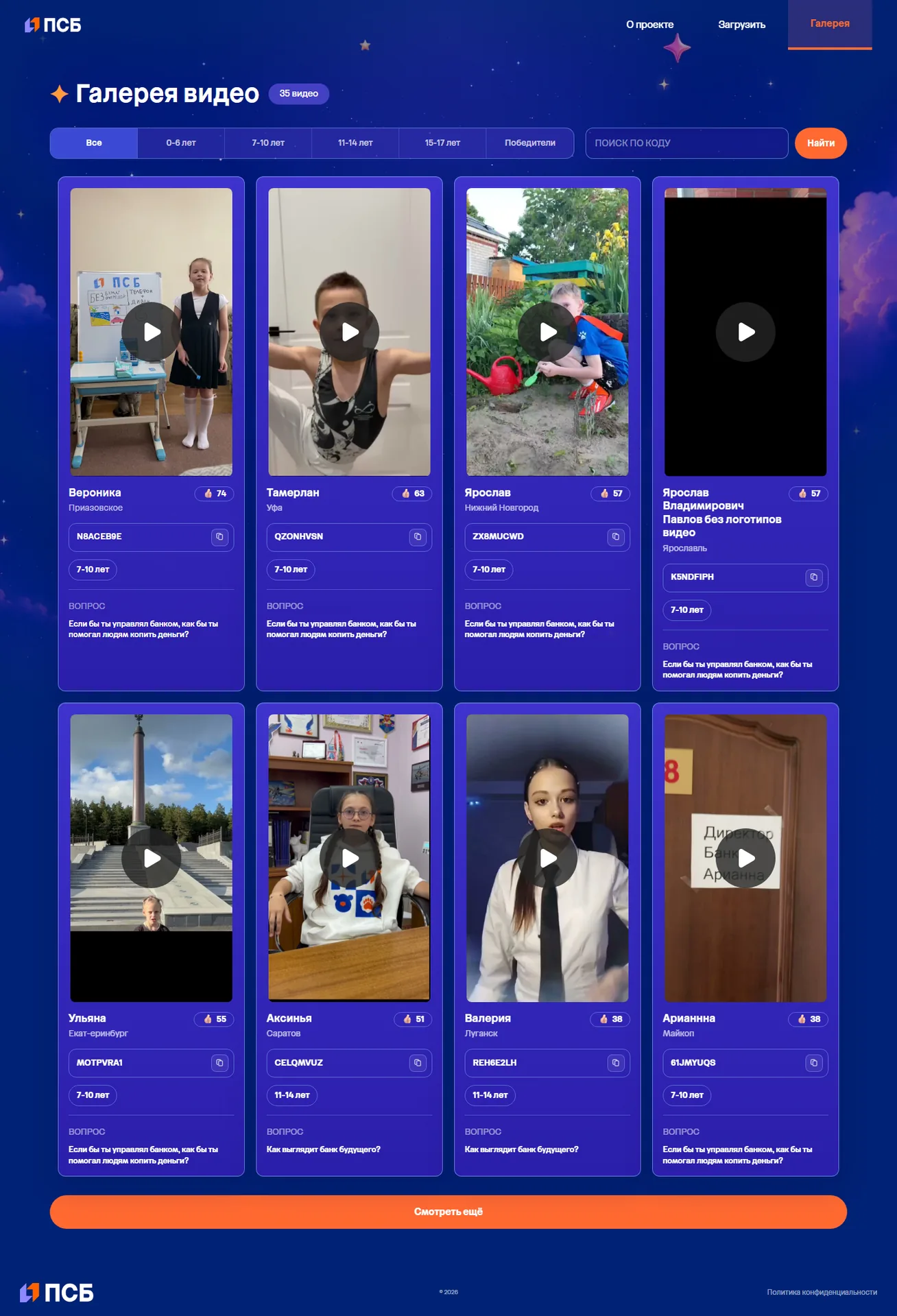
The result: a campaign that ran in a controlled rhythm
After launch, the campaign had a complete digital path: from the first page and video submission through processing, moderation, status checking, and publication in the public gallery. The team had tools to handle incoming material, while participants had a clear way to engage without unnecessary correspondence or uncertainty.
That is what matters in short campaigns: not just reaching launch day, but running the activity calmly with controlled processes and a solid user experience through completion.
Who this type of development is for
This approach fits brands, agencies, and product teams that need a campaign website, a user-generated-content contest, photo or video intake, participant status tracking, moderation, or a public showcase of results. It is especially useful when time is limited but the launch cannot be left to improvised decisions and manual processing.
Practical decision checklist
- Define upload and processing states.
- Keep campaign data authoritative in the application.
- Design moderation and retry paths.
- Verify mobile upload and playback failure journeys.
Sources and methodology
The following references support the facts and technical details in this article:
Need to launch a digital campaign mechanic quickly without creating chaos after launch?
AI-driven development speeds up well-defined stages while retaining engineering control over integrations, user journeys, and launch quality.
Explore AI-Driven Development