
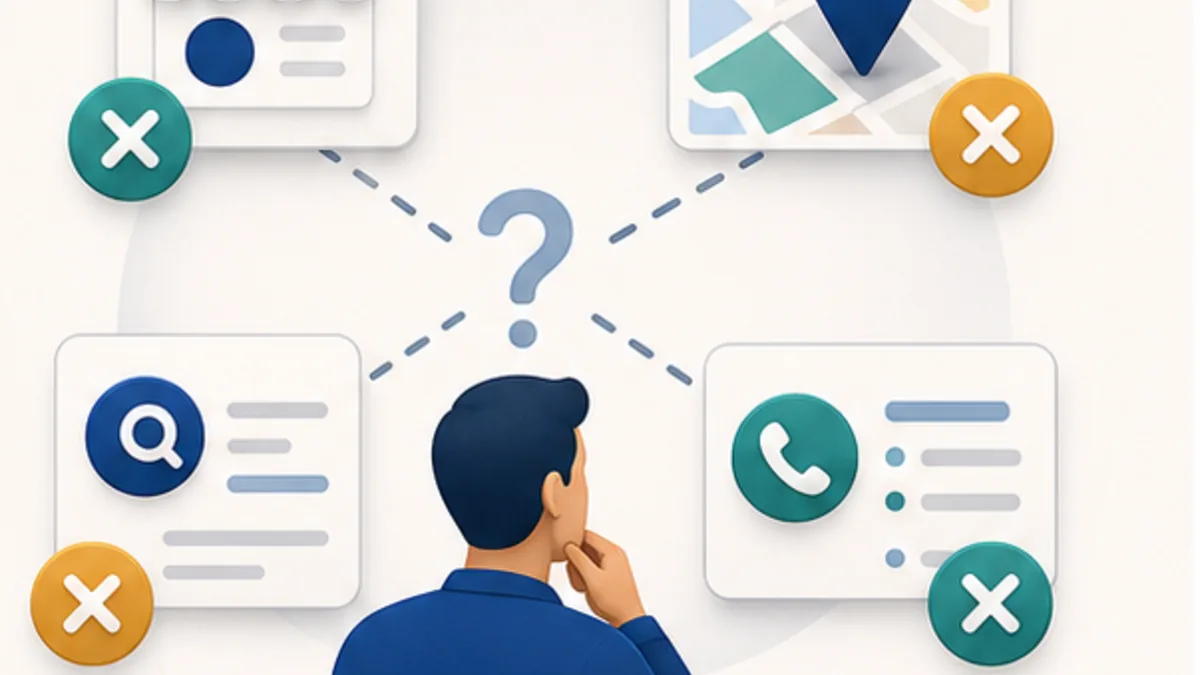
For a small-business owner this can feel strange. The company is real, the service exists, the address exists, the phone number exists, and sometimes there is even a website. But a person opens Google, a map, or a local platform and either does not see the business at all or sees incomplete information, an old address, an empty profile, or a vague description.
That situation often pushes owners to think about “SEO” or paid promotion. But before promotion, the foundation should be checked: do search engines, maps, platforms, and customers understand what the business is, where it is, what it offers, and how to contact it?
Start by looking at the business like a customer
Open a private browser window and search the way a normal customer would search: by business name, by service, by area, by category, and on the map. Not like the owner who knows the exact name, but like someone who remembers only “surf school near me,” “board rental,” “repair shop nearby,” or “cafe in this district.”
If the search result makes it hard to understand whether the business is yours, whether it is open, and what to do next, there is already a problem. Most customers will not investigate. They choose the option that looks clearer.
A common reason is that the website does not explain enough
A website may look good, but search engines and customers need something more basic: clear service pages, address, city, contact options, opening hours, service names, and useful page titles. If the site is built around general phrases like “premium service” or “the best experience,” it may fail to explain what the business actually does.
For local businesses, concrete words matter: the service, the place, the work format, who it is for, how to book, where the location is, and what conditions apply. This does not mean stuffing the site with keywords. It means making the business understandable.
The map profile may be empty or inconsistent
Many customers never reach the website. They look at the map, photos, reviews, hours, route button, and phone button. If the profile is empty, has weak photos, uses the wrong category, or shows an old phone number, the business looks weaker than nearby alternatives.
Check whether the name, address, phone, website, hours, and categories match across the website, maps, and platforms. If one place has one address, another has a different version, and the website has a third format, it creates confusion for people and platforms.
Search may not see the important pages
Sometimes the page exists, but it is not easy for search engines to process. For the owner everything looks fine because the website opens in a browser. But there may be issues with sitemap, robots settings, redirects, duplicate pages, empty titles, or indexing errors that make important pages harder to discover.
This does not need to become a complex technical project. But the basic checks matter: are webmaster tools connected, does search see the site, are there obvious errors, which pages are indexed, and which important pages are missing?
Platform information may become scattered
Service businesses often have many external touchpoints: maps, aggregators, travel platforms, local directories, booking pages, social profiles, and service marketplaces. If each one is filled differently, customers get a fragmented impression.
One platform has no price, another has old photos, a third has the wrong link, and a fourth does not explain how to book. Trust drops before the person ever contacts you.
Without analytics you cannot see where customers disappear
Even when the business starts getting found, the owner needs to understand what is working. Are people coming from search? Clicking the phone number? Opening the route? Moving from maps to the site? Filling the form? Writing in messenger?
Without basic analytics, the owner sees only the final result: “not enough inquiries.” But the real problem may be no visibility, weak clicks, a poor profile, an unclear website, a broken form, or an inconvenient booking path.
Quick checklist: what to check first
- Can people find the business by name, service, and location?
- Do the name, address, phone, and hours match across the website, maps, and platforms?
- Is it clear within 5 seconds what the business offers and how to contact it?
- Do map profiles have good photos, service descriptions, and correct categories?
- Are Search Console or other webmaster tools connected?
- Is analytics tracking calls, forms, buttons, bookings, or messages?
Practical conclusion
If customers cannot easily find the business in Google, maps, or platforms, do not start only with advertising. First put the foundation in order: website, profiles, contacts, descriptions, indexing, and analytics.
This is not a promise of exact search positions or a magic promotion trick. It is the basic layer that helps customers find, understand, and choose the business more easily.
If you are preparing to pay for traffic, use the local-business advertising readiness worksheet. It separates discovery improvements from critical barriers such as a wrong address, lost enquiry or missing staff response before the first test.
Practical decision checklist
- Check indexing and canonical pages.
- Align business name, services, contacts, and location data.
- Complete the most important map profiles.
- Measure calls, routes, messages, and forms.
Sources and methodology
The following references support the facts and technical details in this article:
Need to clean up how your business appears in search, maps, and platforms?
We can review your website, maps, profiles, analytics, and contact paths so customers can find, understand, and choose you more easily.
Open Business Web Presence Setup